

Park · Montreal · ⭐ 9.3/10 · 14530 reviews · updated: 2026-08-04 15:54:40
Address: 3819 Av. Calixa-Lavallée, Montréal, QC H2H 1P4, Канада
Parc La Fontaine — the Plateau’s green living room
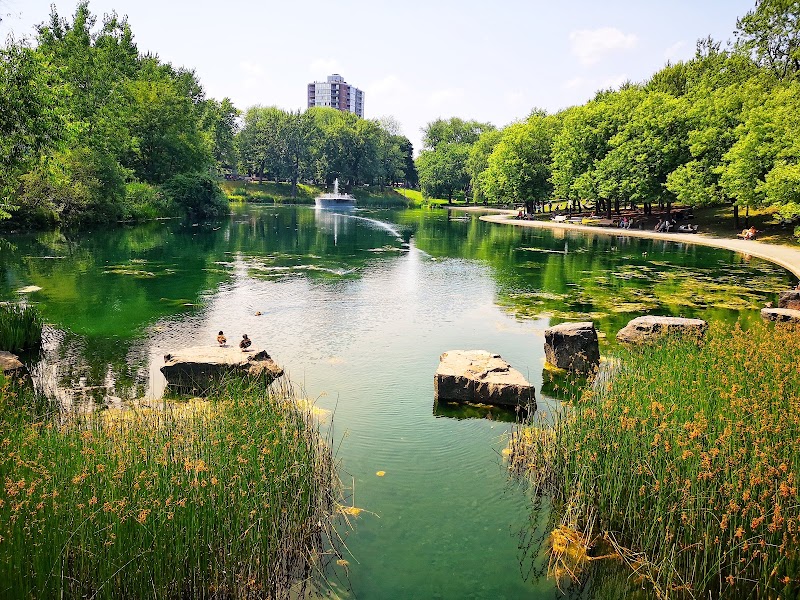
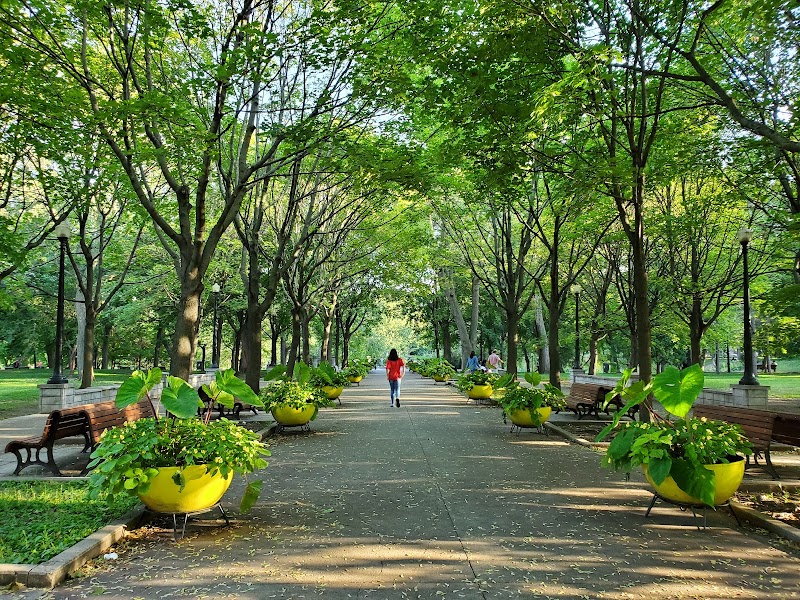
If Mount Royal is Montreal’s mountain, Parc La Fontaine is its living room. Some forty hectares set down in the heart of the Plateau-Mont-Royal, a vault of century-old trees, two ponds joined by a cascade and, at the end of the paths, an open-air theatre you walk into without a ticket: the park was conceived for lingering rather than performing. It is a neighbourhood park in the strong sense — people turn up in their weekend slippers, with a blanket and a book — but it is also the only urban park in Montreal where you can, in a single evening, see a free show, walk along a lit body of water and pass three monuments of Quebec history.
Highlights
- The two ponds — dug in 1900 at different levels and separated by a cascade, they form the heart of the park; a bridge designed by the architect Clovis Degrelle spans them, and an illuminated water feature was installed there as early as 1929.
- The Théâtre de Verdure — an open-air amphitheatre inaugurated on July 8, 1956 on a small island built in the upper basin, closed in 2014 because of its state of disrepair and reopened on June 30, 2022 after a reconstruction by the firm Lemay.
- Espace La Fontaine — the park’s cultural bistro, installed in the restaurant pavilion inaugurated by mayor Camillien Houde in 1953, which had replaced a chalet destroyed by fire in 1944.
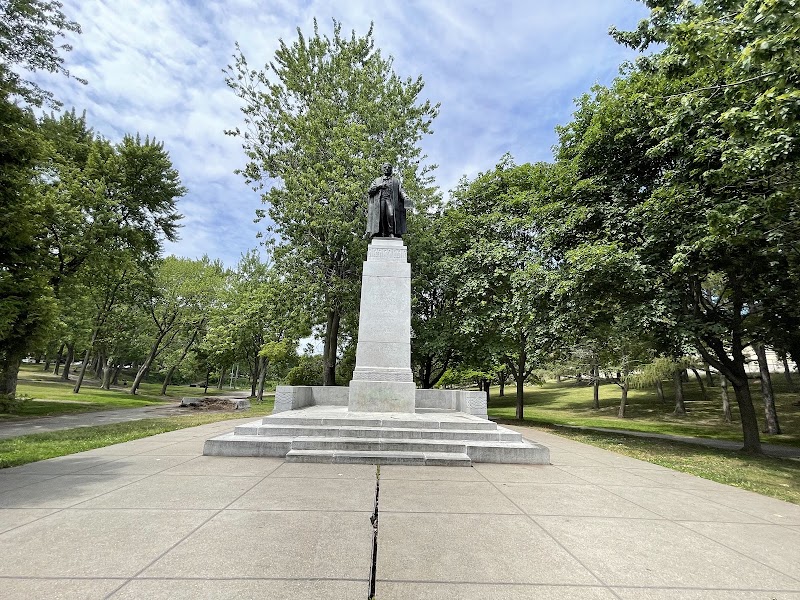
- The monument to Sir Louis-Hippolyte La Fontaine — a bronze by Henri Hébert unveiled on September 28, 1930; La Fontaine wears a judge’s robe and holds a document engraved “responsible government”, and the base carries three bas-reliefs, Liberty, Courage and Legislation.
- The monument to Dollard des Ormeaux — a work by Alfred Laliberté erected in 1920, one of the city’s great outdoor sculptural ensembles.
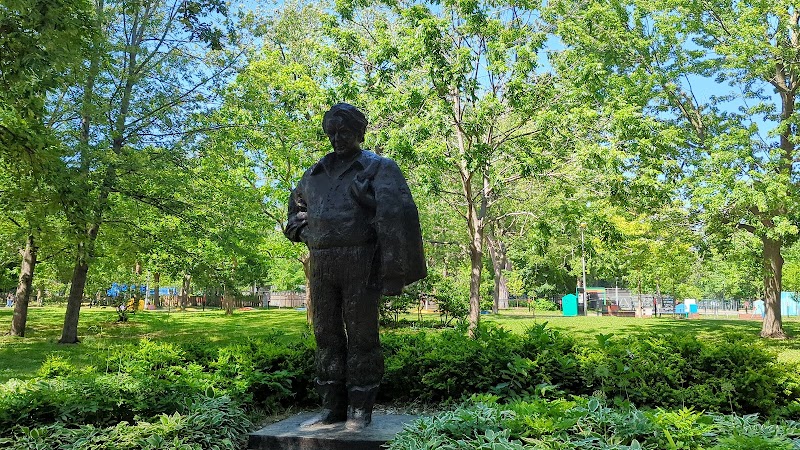
- The statue of Félix Leclerc — installed in 1990, it is a reminder that the Plateau was also the neighbourhood of the chansonniers; an obelisk dedicated to Charles de Gaulle has completed the set since 1992.
What’s inside
The park is organized like a loose checkerboard: large shaded lawns in the middle, the ponds to the north, the sports grounds on the margins, and small squares around the works of public art. It is a very well-equipped park without looking like a sports complex — most of the facilities are slipped in under the trees.
- Tennis and pickleball courts, baseball diamonds, a soccer field and beach volleyball courts.
- A skateboard zone and the Jardin du Petit Monde à bicyclette, where children learn to ride away from traffic.
- Two pétanque courts, play structures for children and for toddlers, and plenty of picnic spots under the canopy.
- A chalet with equipment rental, drinking fountains and a snack bar open in season.
- The Centre culturel Calixa-Lavallée, home since September 2024 to the Maison des Arts Participatifs, and the Théâtre des Merveilles for young audiences.
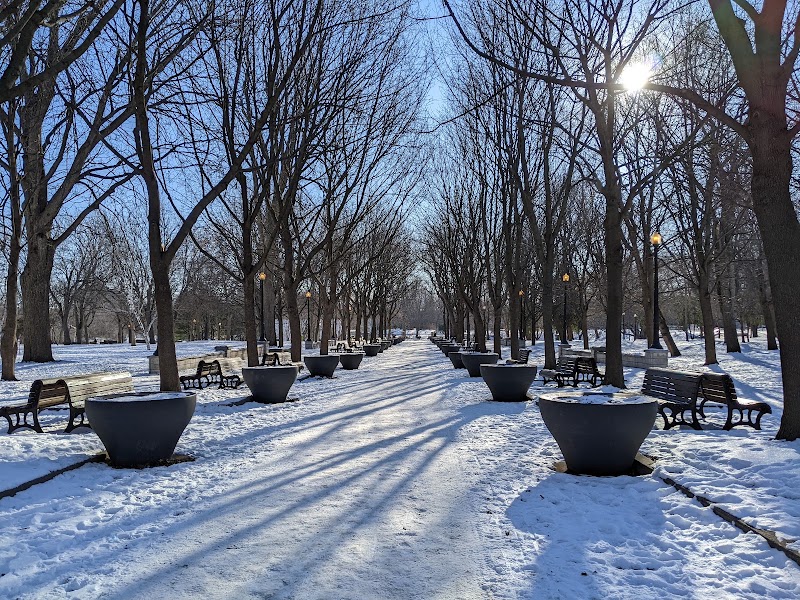
- In winter, several outdoor rinks, including a free-skating oval and a hockey surface, plus classic cross-country ski trails of 2.2 km and 3 km groomed through the park.
What to do and who it’s for
- Show-goers — the Théâtre de Verdure’s summer programme is free and has no box office, on a first-come, first-served basis: dance, music, theatre, circus.
- Families — play structures, learning to ride a bike, the rink in winter and lawns wide enough that a ball bothers nobody.
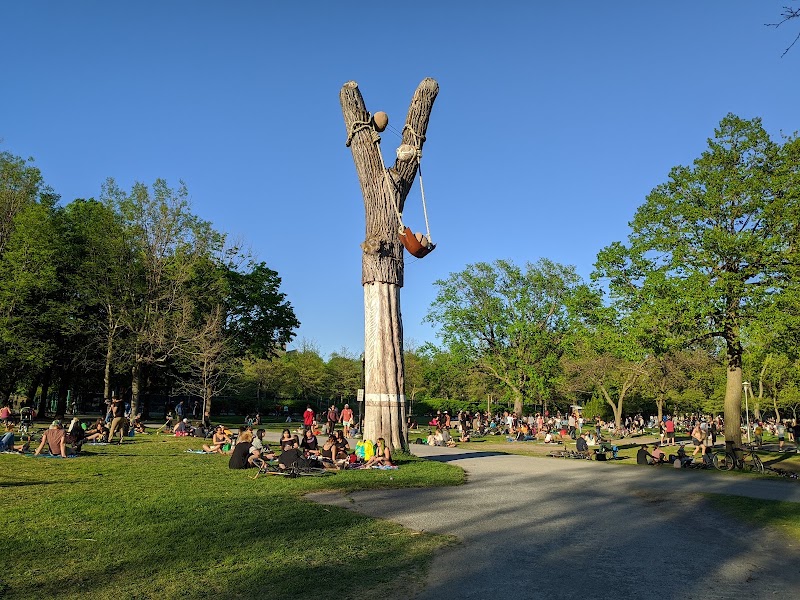
- People who live in the neighbourhood — this is the everyday park: a morning run around the ponds, lunch on the grass, pétanque at the end of the day.
- Fans of public art and history — four major monuments, from 1920 to 1992, can be taken in on a single half-hour loop.
- Neighbourhood athletes — tennis, pickleball, baseball, soccer, beach volleyball and skateboarding coexist without stepping on one another.
- Skaters — as soon as the cold settles in, the park’s ice surfaces become one of the Plateau’s winter meeting places, with adapted sledges lent free of charge.
Getting there and practicalities
The park takes up a large part of the centre-east of the Plateau-Mont-Royal borough, and the orange line borders it on two sides: Sherbrooke station serves the south end, Mont-Royal station the north end, and both are less than a quarter of an hour’s walk from the ponds. Several bus routes run alongside the park, and the Montreal bike network leads straight to it, with bike racks at every entrance. Access to the park is entirely free, with no fence and no ticket booth; the Théâtre de Verdure shows are free as well, and only a few supervised activities and the food at the bistro are charged. The park is open every day from 6 a.m. to midnight. An hour is enough to walk the whole circuit; allow half a day if you are combining a picnic, a show and some sport, and a full evening if you are coming for the summer programme.
When to visit
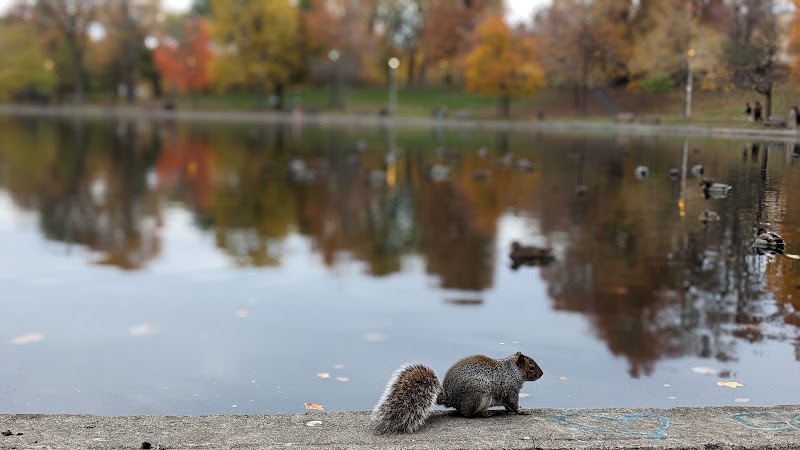
Spring opens the season with the first usable lawns and the basins refilled; it is the quietest moment, when the light still comes through the bare branches. Summer is high season: the vault of big trees holds the shade all day, the Théâtre de Verdure runs free performances one evening after another, and the lawn fills with blankets and picnics from Friday on. Autumn turns the park into a gradient of yellows and reds above the water — probably the finest photograph in the Plateau, and the most pleasant stretch for running. In winter the park flips completely: the outdoor rinks go up, including a free-skating oval and a hockey surface, two classic cross-country trails of 2.2 km and 3 km are groomed between the trees, and the chalet lends or rents the gear, including adapted sledges offered at no charge. An afternoon of skating followed by a hot chocolate at the bistro is an absolute Montreal classic.
Worth knowing
The land comes from the former Logan farm, ceded to the government of Canada in 1845 and used for some forty years as a military manoeuvre ground — which explains the surprising flatness of the site in the middle of a hilly neighbourhood. The city obtained the use of it and opened it to the public in 1874 under the name Logan Park; serious landscaping only began in 1888, and the two basins were dug in 1900. In 1901, as part of the Saint-Jean-Baptiste celebrations, the park was renamed in honour of Louis-Hippolyte La Fontaine (1807-1864), the first francophone head of government of the United Province of Canada and the architect of responsible government. The park was also home to one of the best-loved attractions of post-war Montreal: the Jardin des merveilles, a zoological garden opened in 1957, which drew 750,000 visitors in seven months with its ibises, its flamingos and its Galápagos giant tortoises, and later added a Jonah’s whale with an aquarium in its belly and a sun temple populated with llamas. The Jardin closed for good in the autumn of 1988: on September 24 the animals left for their winter quarters at Parc Angrignon and never came back; some were transferred to the Granby Zoo. The Théâtre de Verdure followed the same arc of wear and rebirth: inaugurated in 1956, closed in 2014, it reopened in June 2022 with a modern technical stage and a capacity of about 2,500, which can go higher when the audience settles on the natural slope of the ground. Another park tradition: the sandcastle competition, held here since 1991.
Visitor tips
- For a show at the Théâtre de Verdure, come early and bring a blanket: there are no reservations, and the grassy slope becomes the best seat in the house once the bleachers are full.
- Walk around the ponds in the direction that brings you to the cascade at the end of the loop — it is the most photogenic point, especially late in the day.
- In winter, check the state of the ice before setting out: after a thaw, the park’s outdoor rinks can close for a few days while the surface is redone.
Questions and answers
Are the park and its shows free? Yes. Entry to the park is open, and the Théâtre de Verdure’s summer programme is given without a box office, on a first-come, first-served basis. Only the food at the bistro and certain supervised activities are charged.
Can you swim or go boating on the ponds? No. The two basins, dug in 1900, are ornamental bodies of water: you walk along them and sit beside them, but you don’t boat on them and you don’t swim in them.
Which métro stations should I use? The orange line frames the park: Sherbrooke for the south end, Mont-Royal for the north end. Both are about ten minutes’ walk from the ponds.
Is there somewhere to eat on site? Yes. Espace La Fontaine, the park’s cultural bistro, occupies the pavilion inaugurated in 1953 and serves meals year-round; a snack bar also operates in season.
What is left of the Jardin des merveilles? Nothing open to the public: the zoo closed in the autumn of 1988 and its animals left, some for Parc Angrignon, others for the Granby Zoo. It survives in the memory of Montrealers and in a few traces in the landscaping.
Is the park interesting in winter? Very much so. Several outdoor rinks are set up, including a free-skating oval and a hockey surface, and two classic cross-country trails of 2.2 km and 3 km are groomed; the chalet supplies the equipment, with adapted sledges lent free of charge.
How much time should I allow? An hour for a full loop on foot, half a day with a picnic and some sport, a whole evening if you are coming for a show.
Is the park suitable for strollers and people with reduced mobility? Yes. The site is almost flat — a legacy of its past as a parade ground — the main paths are wide and easily rolled, and accessible parking and a drop-off zone are provided.
Photos
Show 1 more photos
Visitor reviews
Reviews last updated: 2026-08-04 15:54:40
Data is refreshed monthly. Sources: montreal-name.com and editorial picks based on reviews.
Я був у цьому парку і влітку, і взимку, і ось що я думаю: влітку це ідеальне місце для прогулянки чи пікніка, насолоджуючись прекрасними краєвидами. Відкриті простори та спокійна атмосфера роблять його чудовим місцем для…
It's a very large park. A lot of paths to running and walking. In the center of the park, there is a beautiful lake . It's great to see the people running, cycling and resting here in the park. It has playgrounds and…
Симпатичний парк з відкритим театром на озері, сотнями білок і цікавим рестораном – тут можна дешево поїсти, скористатися WiFi, сходити в туалет, є навіть розважальна програма.